The Only Marketing Channel You Actually Own
By Brennan Lunin, Founder at BL AdWorks
Every channel you use to acquire customers is rented. Google decides what a click costs. Meta decides who sees you. The algorithm changes and your Tuesday changes with it, and you find out afterward.
The list is the exception. Nobody is going to raise the price of emailing people who asked to hear from you.
That is the actual argument for retention, and it does not need a statistic propping it up.
Why I learned this the hard way
I run marketing in-house. Some of the products I run it for sit in restricted niches, the kind where an ad account can get throttled or shut off with no warning and no appeal.
When that happens, you discover very quickly which parts of your marketing you own and which parts you were borrowing. The list keeps working. It is the only thing that does.
I did not choose retention because I read that it had a good return. I chose it because it was the channel that stayed on. Then I ran the same system for products with no such restriction, and it turned out the advantage was not a workaround for a banned ad account. It was just better.
Where the money actually is
Klaviyo publishes benchmarks across more than 183,000 brands, and the split is stark: flows generate about 41% of total email revenue from 5.3% of the sends. Click rates run 5.58% on flows against 1.69% on campaigns, with a placed-order rate roughly 13× higher.
The mechanism is not clever copy. It is that a flow fires because a person did something, and a campaign fires because it is Thursday. Relevance is a timing property before it is a writing property.
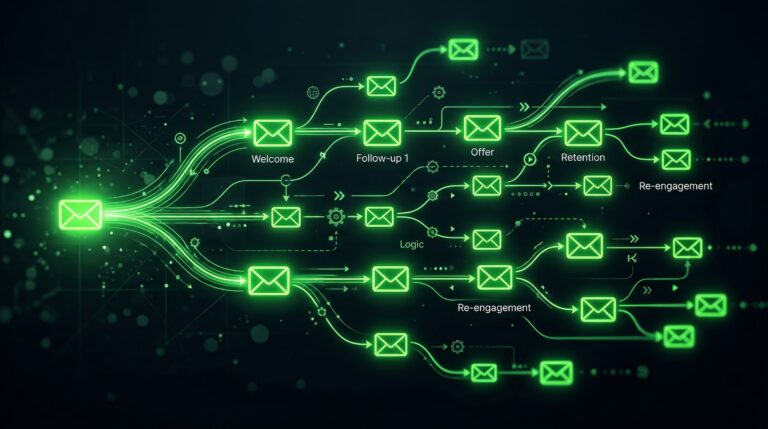
That is what “retention” concretely means. Not a loyalty programme. Not a points widget. It means the emails that trigger on behaviour: welcome, browse, cart, checkout, post-purchase, win-back.
The strategies, in the order I would build them
Get the six flows running. Welcome, browse abandon, cart abandon, checkout abandon, post-purchase, win-back. Most stores have one of these and think they have email.
Make the post-purchase flow do real work. This is the most under-built flow in ecommerce, and for consumable products it is the most valuable. Someone bought a thing that runs out. Know how long yours lasts, then arrive slightly before it does. A replenishment nudge timed correctly beats any discount you could send, because you are not persuading them, you are reminding them.
Segment by behaviour, not by demographics. What someone bought and when they last opened an email tells you more than their age or their city ever will. You already have the first kind of data. The second kind you would have to guess at.
Suppress the dead. This one feels wrong and it is right. People who never open are not a dormant asset, they are a deliverability liability, and they are pulling your inbox placement down for the people who do want to hear from you. Set a sunset policy and actually enforce it.
Give people a reason to open the next one. The unglamorous truth of retention is that it is a series of small deposits. Every email that wastes someone’s attention makes the next one worth less.
The comparison that gets misused
You have read that retaining a customer costs a fraction of acquiring one. It gets quoted with a number attached, usually five, sometimes seven, and the number rarely has a source under it.
Ignore the number. The direction is the part that matters and the direction is not controversial: you are not paying an auction to reach someone who already bought from you. That is not a statistic, it is arithmetic about who owns the channel.
The mistake is treating that as an argument to stop acquiring. It is not. You cannot retain people you never got. Acquisition fills the top, retention decides whether filling it was worth it.
What retention does not fix
It does not fix a bad product. If people buy once and do not come back, sometimes the flow is broken and sometimes the thing is just not good enough to buy twice, and the flow cannot tell you which. It will just make the second failure more expensive.
It does not fix a broken product page either. A retention system compounds whatever your store does with a visitor. If the store converts badly, you are compounding a small number.
And it does not work immediately. Flows earn their keep on a lag, because they wait for people to do things. A campaign pays today. A win-back flow pays in sixty days, quietly, and you have to be the kind of operator who can wait for that.
Where to start
Open Klaviyo. Look at what share of your email revenue comes from flows rather than campaigns.
If it is well under 40%, you have found your gap, and you did not need a benchmark to find it. You needed to look.
Sources: Klaviyo email marketing benchmarks (183,000+ brands).
Get the 6 core Klaviyo flows, free.
Welcome, browse abandonment, cart abandonment, checkout abandonment, post-purchase, win-back. Built in your Klaviyo account, by me. No cost while the first 50 spots last.
Claim your flows free →Want the whole retention system built instead? See how that works.