The Ecommerce Email Playbook: What Flows Do That Campaigns Cannot
By Brennan Lunin, Founder at BL AdWorks
Most stores I look at send campaigns and call it email marketing. The newsletter goes out Thursday, it does something or it does not, and everyone moves on.
The flows sit empty. And the flows are where the money is, which is not my opinion.
The one number that reframes everything
Klaviyo publishes benchmarks across more than 183,000 brands on its platform, and the split it reports is the most useful thing I know about ecommerce email:
Flows generate about 41% of total email revenue from 5.3% of the sends.
Read that twice. Nineteen sends out of twenty are campaigns, and they bring in a little under 60% of the revenue. One send in twenty is a flow, and it brings in the other 41%.
The rest of the picture is consistent with it. Klaviyo reports flow click rates of 5.58% against 1.69% for campaigns, and a placed-order rate roughly 13× higher. Revenue per recipient runs about 18× higher on flows than on campaigns.
There is nothing magic in the emails. A flow email is often worse-written than a campaign, because nobody agonises over it. What a flow has is timing. It arrives because the person did something, at the moment they did it. A campaign arrives because it is Thursday.
That is the whole difference, and it is worth roughly eighteen times per recipient.
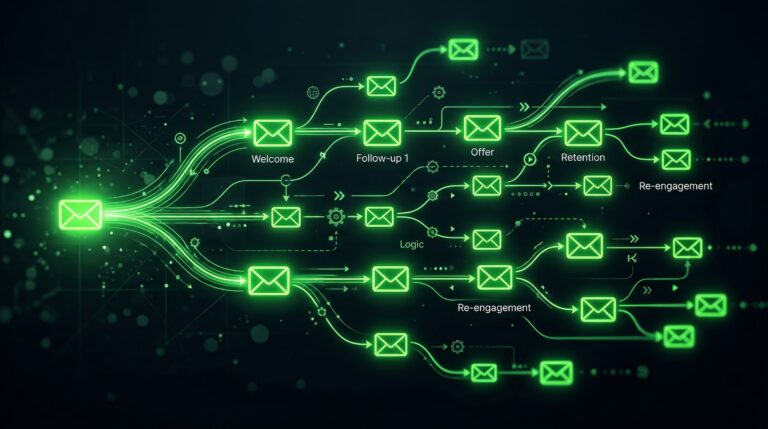
The six flows, and what fires them
Welcome (3 emails, 5 days). Fires on signup. Email one confirms the subscription and delivers whatever you promised, immediately. Not in an hour. If someone hands over an email for a code and the code takes an hour to arrive, they have closed the tab.
Check one thing before you build it: if your storewide banner already shows a public discount code to every visitor, your signup form is asking for an email in exchange for something you already gave away for free. I ran into exactly that on a real store recently, and it quietly undercuts the entire flow.
Browse abandon (2 emails, 24 hours). Fires on Viewed Product. Filter it against anyone who already added to cart, and anyone who has been through this flow in the last 7 days. Without those two filters you will email someone who is actively shopping right now, which reads as surveillance rather than service.
Cart abandon (3 emails, 48 hours). Fires on Added to Cart. Filter against Placed Order, and against anyone who got this flow in the last 30 days.
Do not lead with a discount. The people who were going to buy do not need one, and the people who were not are learning that if they stall, you pay them.
Checkout abandon (2 emails, 24 hours). Fires on Started Checkout. Set it to a higher priority than cart abandon in Klaviyo’s smart sending, or you will double-send the person who did both, which is most of them.
Someone who reached checkout and stopped hit a specific wall: a shipping number they did not expect, a payment method you do not take, a form that broke on their phone. That is a different person from the browser, and they deserve a different email.
Post-purchase (4 emails, 90 days). Fires on Placed Order. Fork first-time buyers from repeat buyers on order count.
Most stores treat this as a receipt. For anything consumable it is the highest-leverage flow you own. If someone buys a product that runs out in three weeks, a replenishment nudge timed to week three is worth more than any discount you could send.
Win-back (4 emails, 30 days). Fires when a customer with at least one order goes 60+ days quiet. Filter against anyone who already got it in the last 90 days.
If they do not engage after the win-back, suppress them. Continuing to mail people who never open is how you damage deliverability for everyone who does.
Campaigns still matter, but differently
Campaigns are how you stay present between purchases. The mistake is judging them by the same yardstick as flows: they will lose that comparison every time, and the Klaviyo numbers say by roughly 18×.
The thing to watch on a campaign is not revenue, it is click-to-open. It tells you whether the segment still wants to hear from you. Widen your engaged segment until that number drops, then stop widening. That is the signal to send less, and almost nobody obeys it.
What I am not going to tell you
I am not going to tell you what your welcome flow will earn.
You will find posts that do, with tidy ranges attached to every flow. I do not know your margins, your traffic, your offer, or your list, and neither do they. Klaviyo’s numbers above are aggregate across 183,000 brands, which makes them a real fact about the platform and a terrible prediction about you.
What I can tell you is which flows exist, what fires them, and which filters stop them colliding. That part is the same for every Shopify store running Klaviyo, and it is the part that is usually broken.
Where to start
Welcome and cart abandon. Those two cover the person who gave you their email and the person who got closest to buying. Add browse abandon once they are clean.
Then go look at the split: what share of your email revenue comes from flows? If it is well under 40%, you have found your gap, and you did not need a benchmark to find it.
Sources: Klaviyo email marketing benchmarks (183,000+ brands).
Get the 6 core Klaviyo flows, free.
Welcome, browse abandonment, cart abandonment, checkout abandonment, post-purchase, win-back. Built in your Klaviyo account, by me. No cost while the first 50 spots last.
Claim your flows free →Want the whole retention system built instead? See how that works.